Top 5 of 9 shown — full shortlist above.
The short answer
An automatic litter box is worth buying if you have at least one healthy adult cat between roughly 5 and 22 pounds, clumping litter you’re willing to standardize on, and a spot to put a unit that’s bigger than a standard pan. For most multi-cat homes, a globe-style robot like the Litter-Robot 4 or CATLINK Scooper Luxury Pro-X earns its keep fastest. For a single cat in a small space, a compact cube like the PETKIT Pura X or a tray-based rake system like the PetSafe ScoopFree Ultra gets you most of the benefit for less money and less floor space.
This isn’t a niche gadget anymore. Forbes Vetted’s reporting on whether automatic litter boxes actually work, and separately on their disadvantages, lands on a similar conclusion to what shows up across cats.com’s and CNN Underscored’s buying guides: these units are genuinely useful for the right cat and household. They come with real conditions attached—a cat that tolerates the noise and motion, an owner willing to keep the mechanism clean, and litter that matches what the machine was built for. That conditional endorsement is most of what this guide is about.
Who actually benefits from an automatic litter box
- Multi-cat households where scooping twice a day, every day, isn’t realistic
- Anyone with a demanding schedule, mobility limits, or a bad back who struggles to scoop consistently
- Owners who want a health-monitoring assist: weight trends and visit frequency can flag issues before they become a vet visit
- People who’ve noticed litter box avoidance tied to a dirty box. Research on litter box preference published in the Journal of Veterinary Behavior found cats have a strong, measurable preference for cleaner litter over soiled litter. Multi-cat homes are told to keep more boxes than cats in the first place, per AAHA’s feline life-stage guidelines.
An automatic box isn’t right for every cat. Petful’s review of automatic litter box risks and benefits and a separate safety analysis from Neakasa both point to the same vulnerable groups: kittens too small or light to register on weight sensors, frail senior or arthritic cats who struggle to climb into a raised globe, and anxious cats in a new or unstable environment. Cheap unbranded imports add mechanical risk on top of that, since sensor quality and pinch protection vary widely outside the established brands. If your cat is skittish, the noise and motion of a self-cleaning cycle can itself become the problem. Petful and HomeRunPet’s troubleshooting guide both note that cats sometimes avoid a self-cleaning box specifically because of the sound or movement of a cycle starting while they’re still nearby. For an anxious cat in an unfamiliar environment, an automatic box can increase stress and accidents rather than reduce them.
The main types, mapped
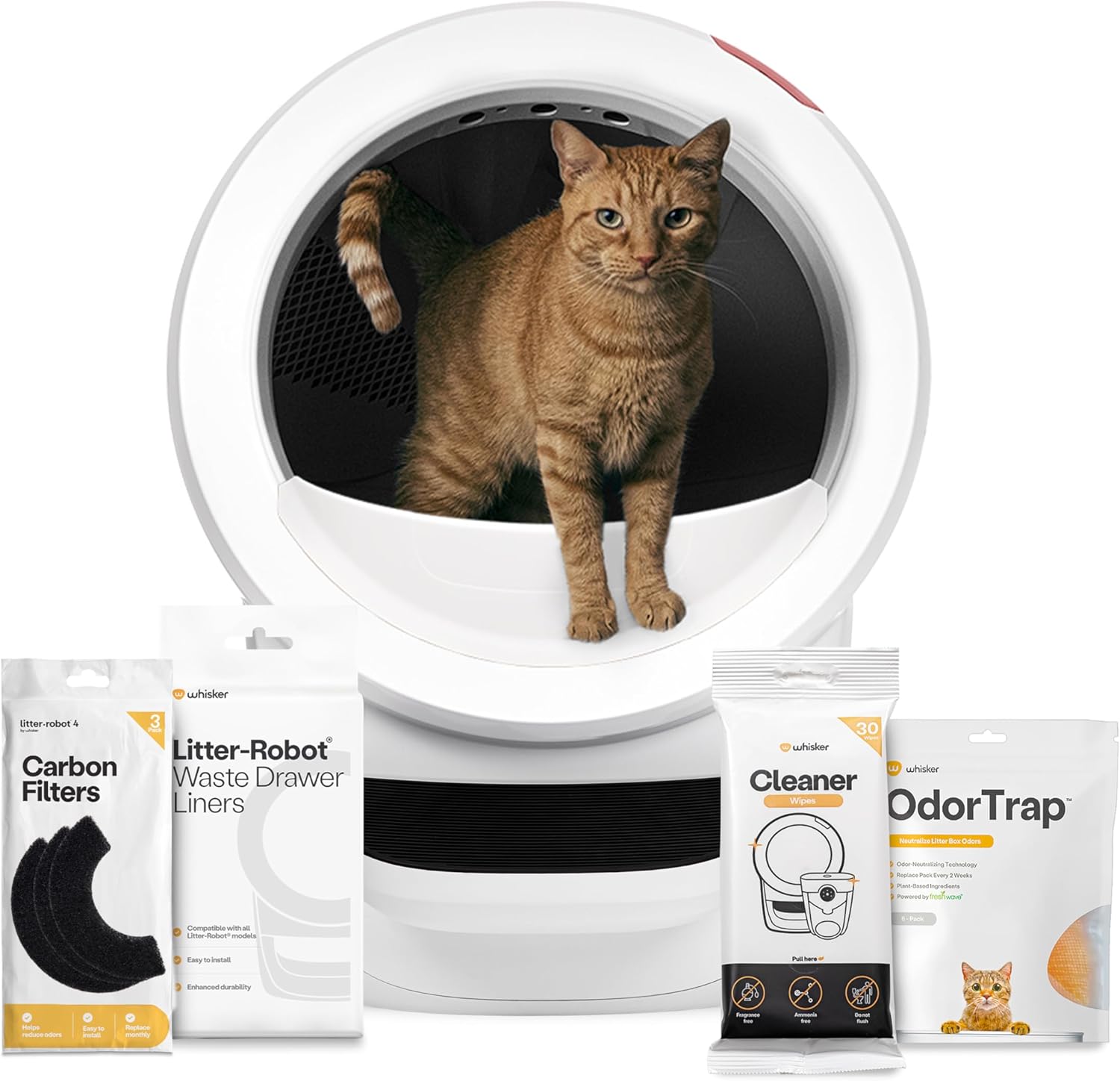
Globe/dome sifting robots (Litter-Robot 4, Litter-Robot EVO). A rotating globe separates clumps from clean litter after each visit and drops waste into a sealed drawer. This is the category leader for multi-cat homes and, per Forbes Vetted’s and cats.com’s roundups, has the longest track record and widest service network of any automatic litter box brand. The trade-off is footprint: these are the largest units on this list, and they need clumping litter to sift correctly.
Sealed-cylinder robots (PETKIT PuraMax 2, PETKIT Pura X). A similar sifting mechanism in a cylinder or cube shape, generally with a lower entry threshold than a globe. PuraMax 2’s 360° ShieldBase sealed cylinder is built specifically to resist leaks from cats who spray at the base or edge, which HomeRunPet’s troubleshooting guide flags as a real weak point in some robot designs. Pura X trades interior room for a smaller footprint suited to one cat, not several.
Rake/tray systems (PetSafe ScoopFree Ultra, ScoopFree Complete Plus, ScoopFree Crystal Smart). A rake glides through a disposable crystal-litter tray on a timer—5, 10, or 20 minutes after use on the Ultra—and pushes waste into a covered compartment. No washing the unit and no scooping, but you’re buying proprietary trays indefinitely instead of bagged litter. This is the lowest up-front cost tier and the smallest footprint of the group, which is why it’s the default recommendation for one cat in a studio, bathroom, or laundry nook. The three ScoopFree models differ mainly in extras: Complete Plus adds a larger 25-lb litter capacity, Crystal Smart adds Wi-Fi alerts through the My PetSafe app, and Ultra is the base hooded version.
Plumbed self-washing systems (CatGenie A.I.). Instead of disposable litter, this connects to a cold water line and a drain, then scoops, flushes, washes with SaniSolution, and air-dries reusable granules. You never buy litter again, but installation is a real plumbing project, not a plug-and-play swap, and it’s the one unit here that isn’t portable once installed.
Multi-cat health-tracking robots (CATLINK Scooper Luxury Pro-X). This is functionally a globe/cylinder hybrid, but it’s worth calling out on its own because it leans hardest into per-cat reporting and interval length: a 13-liter waste bin rated for up to 14 days with one cat, and a 65-liter globe capacity that’s meaningfully larger than most competitors. That combination makes it the pick when three or four cats share one household and you need to know whose habits changed, not just that something changed.
Litter-Robot 4 vs. CATLINK Pro-X: picking between the two flagships
These two get grouped together constantly in roundups as “best for multi-cat,” but they’re not interchangeable, and one is a clearer default than the other for most buyers. Litter-Robot 4 has the longer track record, the largest waste drawer in the Whisker lineup at 9-10 lbs (7-8 liters), and—per both Forbes Vetted and cats.com—the most mature app and customer support infrastructure of any brand in this category. That maturity matters if something goes wrong: replacement parts, warranty service, and troubleshooting documentation are all more established for Litter-Robot than for CATLINK.
CATLINK’s Pro-X counters with raw capacity and quiet operation: a 65-liter globe (versus Litter-Robot 4’s smaller internal volume), a 13-liter waste bin rated for up to 14 days per cat, and a listed 40dB noise level, which is quieter than most globe robots running a full cycle. Its quad-layer odor system claims roughly 90% odor removal, and its health reporting is built around tracking individual cats by weight, which is a genuine edge in a four-cat household where Litter-Robot 4’s sensors are less granular about who’s using the box how often.
If you want the safer, more established buy with the deepest support network, Litter-Robot 4 is the default choice and it’s why it keeps topping outlets like CNN Underscored’s and Forbes Vetted’s best-of lists. If you specifically need the longest stretch between emptying and the most detailed per-cat data in a house with three or more cats, Pro-X’s larger bin and reporting depth are the more specific tool for that job—but you’re trading some of that brand maturity to get it.
Why automatic boxes tend to control odor better
The mechanical logic matters more than marketing copy about “triple odor control.” A traditional box sitting unscooped for hours between cleanings will smell regardless of how good the litter is, because waste sitting exposed to air continues to off-gas the compounds responsible for litter box odor. Automatic boxes cycle shortly after a cat leaves the box rather than waiting for a human to notice or find time to scoop, which limits how long waste sits exposed before it’s sealed away. That timing advantage is structural—it’s not something a scented litter or a stronger air freshener can replicate, because fragrance masks smell rather than removing its source.
Carbon filters and sealed drawers, like Litter-Robot’s OdorTrap system, PETKIT’s N50 2.0 deodorizer (which the brand states removes roughly 98% of ammonia), and CATLINK’s quad-layer system (rated at roughly 90% odor removal), matter for containing whatever smell does escape. But the bulk of the odor-control benefit comes from how quickly the cycle runs, not from what’s inside the filter cartridge.
Best cat litter for odor control in an automatic box
Clumping clay litter is the safe, near-universal answer for globe and cylinder robots, because these mechanisms are engineered to sift and detect firm clumps; most automatic litter boxes are built around clumping clay and struggle with litter that doesn’t clump firmly and separate cleanly from the rest of the tray. Crystal litter is the exception that works, but only in systems designed for it, namely the PetSafe ScoopFree line, since crystal litter absorbs and dehydrates waste instead of clumping it. That’s exactly why it fails inside a sifting robot but works fine in a rake-and-tray design built around it from the start. Whatever type you use, a low-dust, unscented formula is the safer default: heavy fragrance doesn’t address odor at its source, and AAHA’s general litter box guidance notes that strongly scented litter can be an added deterrent for scent-sensitive cats, on top of everything else that can already discourage box use.
How to choose: every dimension that matters
Number and size of cats. Check the stated weight range and cat-count capacity, not just the marketing name. The EVO (3-19 lbs) and Pura X are built for one or two cats; Litter-Robot 4 and CATLINK’s Pro-X (3.5-22 lbs) are rated for larger, multi-cat households and heavier cats.
Entryway height and threshold. A high step-in globe can be a real obstacle for small, senior, or arthritic cats. Litter-Robot 4’s entryway sits at 15.8 x 15.8 inches, which is manageable for most adult cats but worth measuring against a cat with mobility issues. Low-entry designs like PuraMax 2’s sealed base or Pura X’s 8.6-inch, 12-inch-off-ground entryway matter more than most buyers expect until they own an older cat with stiff hips.
Litter type compatibility. This is one of the most common sources of buyer disappointment, according to HomeRunPet’s troubleshooting guide and Meowant’s fix-it guide. Confirm upfront whether a unit needs clumping clay (most globes and cylinders) or disposable crystal trays (the ScoopFree line), and don’t assume you can swap freely later—the mechanisms are built around one or the other, not both.
Waste drawer size and cycle frequency. Bigger drawers, like Litter-Robot 4’s 9-10 lbs (7-8 liters) or CATLINK’s 13-liter bin rated for up to 14 days with one cat, mean fewer bag changes. That matters far more with multiple cats than with one, where even a smaller drawer like PuraMax 2’s 7-liter bin can stretch up to 15 days.
Noise and cycle delay. If you have an anxious or noise-sensitive cat, look for adjustable delay settings, such as the EVO’s 3-30 minute range or ScoopFree’s 5/10/20-minute options, and quieter cycle designs. CATLINK lists a 40dB operating noise level as a useful reference point for comparison shopping.
Sensors and safety. Weight sensors, infrared, thermal, and anti-pinch detection all exist to keep the mechanism from running while a cat is inside or nearby. Pura X’s sensor suite (thermal, infrared, weight, anti-pinch) and CATLINK Pro-X’s 11 sensors including weight and proximity are on the higher end of what’s available. More sensor types generally means fewer false triggers and safer operation, but also more components that can get dirty, miscalibrated, or need occasional troubleshooting.
App and health tracking. Weight logs and visit-frequency tracking, offered in some form by every app-connected model listed here, can catch early signs of a UTI, weight loss, or reduced appetite before they become obvious. This partly offsets a real downside that Forbes Vetted raises in its piece on automatic litter box disadvantages: you’re not visually inspecting waste the way you would scooping by hand, so subtle changes in blood or stool texture are easier to miss without a model that tracks the trend data instead.
Footprint and installation. Globes and cylinders need real floor space and a nearby outlet; the Pura X alone measures 19 x 21 x 25 inches, and CatGenie needs an actual water line and drain connection. Measure the space before you buy, especially in an apartment or a shared bathroom.
Ongoing cost. Rake-tray systems and CatGenie both carry a recurring cost that a straight sifting robot running standard clumping litter doesn’t: disposable crystal trays for the ScoopFree line, and SaniSolution cartridges for CatGenie. Robots aren’t necessarily free to run either, since litter still needs periodic topping off and full changes, but the sifting mechanism is generally credited across owner reviews and outlets like cats.com with reducing how much litter gets thrown out compared to manual full-box changes, since only waste and its immediate clumps get removed rather than the whole tray.
Common mistakes buyers make
- Buying based on cat count alone and ignoring weight range. A capacity of “up to 4 cats” doesn’t help if one of those cats is an 18-lb Maine Coon and the unit’s sensors are calibrated for lighter cats. Check the weight range, not just the headline capacity number.
- Using the wrong litter for the mechanism. Per HomeRunPet’s and Meowant’s troubleshooting guides, most cleaning complaints trace back to litter choice and fill level rather than a defective machine. If clumps are left behind or waste sticks to the drawer, check litter type and depth against the manufacturer’s spec before assuming the unit is broken.
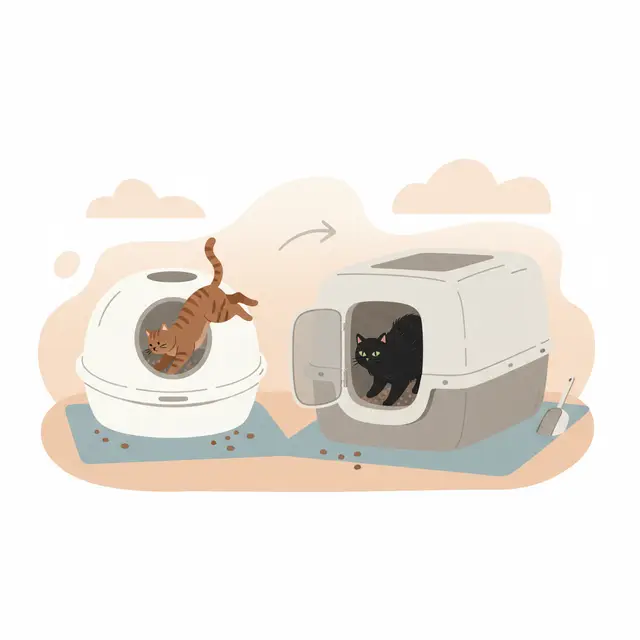
- Skipping the adjustment period. The most common first-time complaint, according to both HomeRunPet and Meowant, is a cat that won’t approach the box at all after setup. The standard fix is introducing the unit unplugged for three to seven days, transferring scent from the old box, then powering it on gradually once the cat is using it comfortably. This resolves most avoidance within roughly two weeks. Buyers who return the unit after a couple of days are often giving up before the adjustment process has really started.
- Treating the app and sensors as a replacement for occasionally checking the box yourself. Health tracking is a genuine benefit, but it’s a supplement to noticing changes, not a substitute for periodically looking at what’s actually in the drawer. Sensors can miss subtle shifts in stool consistency or blood that a person would catch in five seconds during a manual check.
- Ignoring where the unit will live before buying it. A globe robot that doesn’t fit through a hallway door, or a CatGenie that needs a water line nowhere near an available bathroom or laundry hookup, are return-triggering mistakes that show up repeatedly in owner reviews cited by cats.com and CNN Underscored. Measure the space and confirm installation requirements before ordering, not after it arrives.
The bottom line
There’s no single best automatic litter box, just a best fit for a specific cat count, budget, and space. For most multi-cat households prioritizing reliability and support, Litter-Robot 4 remains the safer default pick according to the major outlets covering this category. For households that need the longest stretch between emptying and per-cat health data, CATLINK Pro-X’s larger bin and reporting are worth the trade-off in brand maturity. For a single cat in a small space, the PETKIT Pura X or a ScoopFree tray system gets most of the benefit without the footprint or cost of a full robot. Whatever you choose, the biggest driver of success isn’t the model, it’s matching litter type to mechanism and giving your cat a real adjustment period before deciding it isn’t working.
Keep reading
Sources